The edge bevel is the strip of steel you sharpen, but the grind behind it decides everything else. Grind is the taper from the spine down toward the edge, and it controls how thin the blade sits behind the cutting edge, how much material supports that edge, and how much work a sharpening session becomes. Two knives with identical outlines and identical steel can behave like different tools once the taper changes.
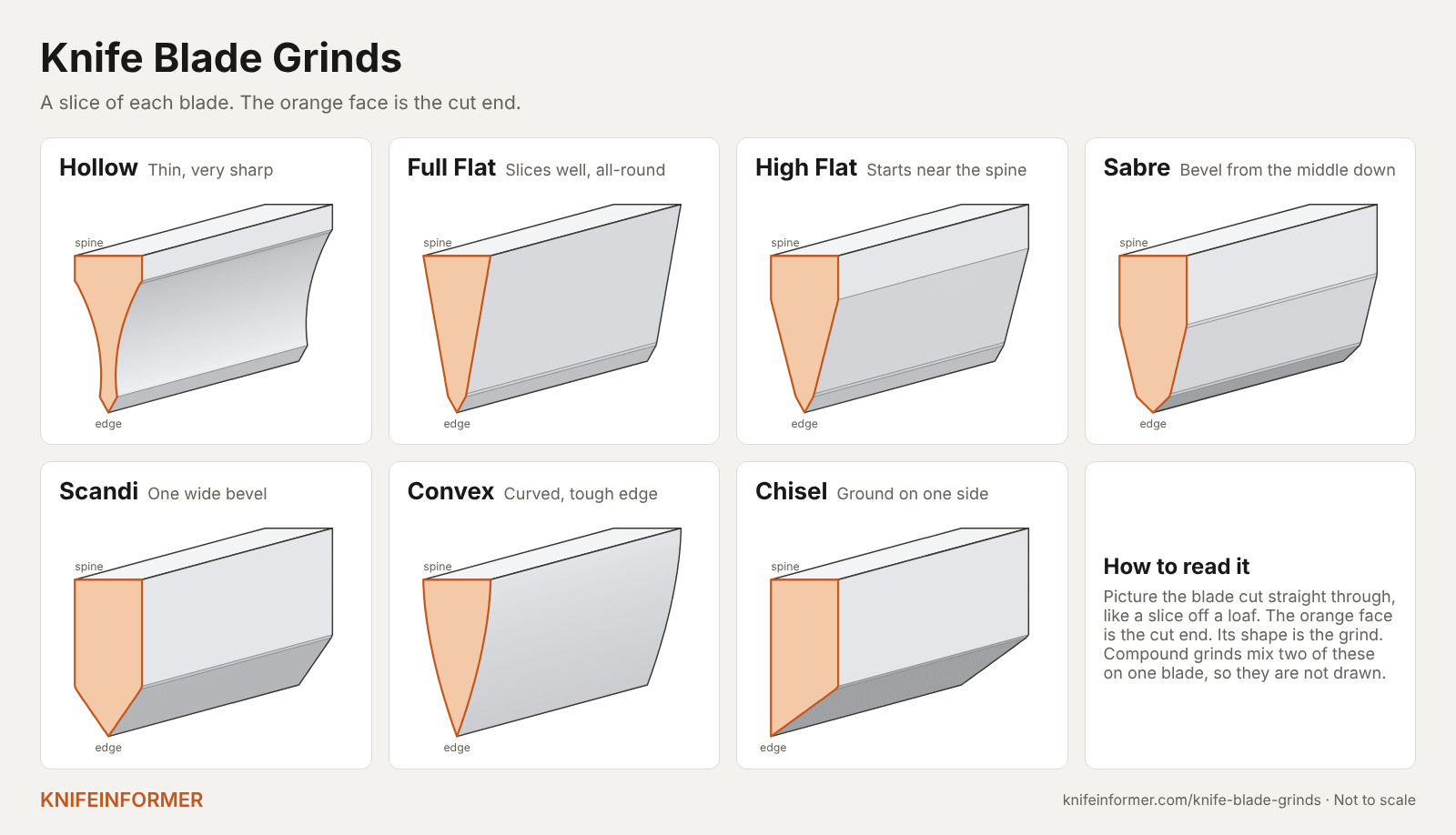
Read the chart as a map of trade-offs rather than a ranking. Every grind buys one property by spending another, and the spending is predictable enough to shop by once the categories are clear.
Where the thin grinds win
Hollow grinds are cut on a wheel, so the sides curve inward and the steel just above the edge gets very thin. That is why a hollow-ground blade feels sharper than its measured angle suggests and why it slides through cardboard, rope and food with so little drag. It is the traditional geometry on straight razors, on hunting knives and on a large share of pocket knives for exactly that reason.
Full flat grinds taper in a straight line from spine to edge. There is more steel behind the edge than a hollow grind leaves, which makes it the sensible default for a knife that has to slice well and survive being pried at. Kitchen knives live here, and so do most modern EDC folders. A high flat grind is the same taper started slightly below the spine, keeping a narrow strip of full thickness along the top: slightly stiffer, slightly stronger, and in daily use almost impossible to tell apart from a full flat.
Chisel geometry removes steel from one side only, which makes it fast to sharpen and capable of a very keen edge. Japanese single-bevel kitchen knives, the deba and yanagiba among them, use it, as does the kiridashi utility blade. The cost is directional: it steers the cut slightly off-axis and most production versions are set up for right-handed users.
Where the geometry gives it back
The thin edge of a hollow grind chips or rolls under twisting cuts and impact, which is why nobody recommends one for chopping or batoning. A sabre grind takes the opposite approach: the flat runs from roughly the middle of the blade or lower, leaving the upper half at full thickness. That mass makes it tough, and it explains the grind's presence on tactical and military patterns. The steep bevel near the edge also pushes material apart instead of slicing through it, so it is a poor choice for food prep.
Scandi grinds run one wide, flat bevel straight to the edge with no secondary bevel, apart from the microbevel many production knives add. The wide bevel bites into wood for carving and feather sticks, and sharpening is close to foolproof because the bevel itself sets the angle on the stone. Ask it to slice cardboard or tomatoes and the same geometry that helps in wood becomes drag.
Convex geometry curves outward like an axe, leaving more steel behind the edge. Fallkniven builds its survival line around it, and it shows up on choppers, where impact resistance matters more than outright keenness. Flat stones make it awkward to maintain, so most owners strop on leather or sandpaper over a soft backing to preserve the curve.
Compound grinds stack two geometries on one blade, usually a hollow or flat main grind with a separate flat-ground section at the tip. On tanto profiles the point takes the abuse, so the extra steel there is deliberate. Sharpening stays simple because the edge bevel runs at one angle along the whole length; the two main grinds only meet higher up.
| Grind | Slicing | Toughness | Sharpening | Typical use |
|---|---|---|---|---|
| Hollow | Excellent | Lower | Easy | EDC, hunting, straight razors |
| Full flat | Very good | Medium | Easy | All-round EDC, kitchen |
| High flat | Very good | Medium | Easy | Modern folders |
| Sabre | Fair | High | Easy | Tactical, military, hard use |
| Scandi | Good | Medium | Very easy | Bushcraft, woodwork |
| Convex | Good | High | Harder | Chopping, survival, axes |
| Chisel | Good | Medium | Very easy | Tactical, Japanese kitchen |
| Compound | Good | Medium to high | Medium | Tanto, tactical |
One number beats the table: blade thickness behind the edge. A 0.020-inch edge on a full flat grind will out-slice a 0.030-inch edge on a hollow grind every time, because the geometry that matters is measured in thousandths near the apex, not in the shape of the sides. Makers who publish that figure are telling buyers more than a grind name does.
The variable to watch is how factories pair grind with harder steels. Thin geometry in a high-vanadium steel at 62 HRC chips where the same geometry in 14C28N would roll, which is why some brands keep hedging toward sabre and convex profiles as hardness climbs.