Three Shun Premier knives, an 8-inch kiritsuke, a 5.5-inch nakiri and a 7-inch santoku, came back from five years of home cooking with damaged edges. The owner says they were honed regularly, washed and dried after use, and stored in the sheaths they arrived in. The photos went up on r/knives under the title "Damaged Blades."
Nothing in that routine sounds abusive, which is exactly why the thread filled up. The knives are hard, thin and ground to a narrow angle, and three habits that are fine on a European chef's knife are not fine on these.
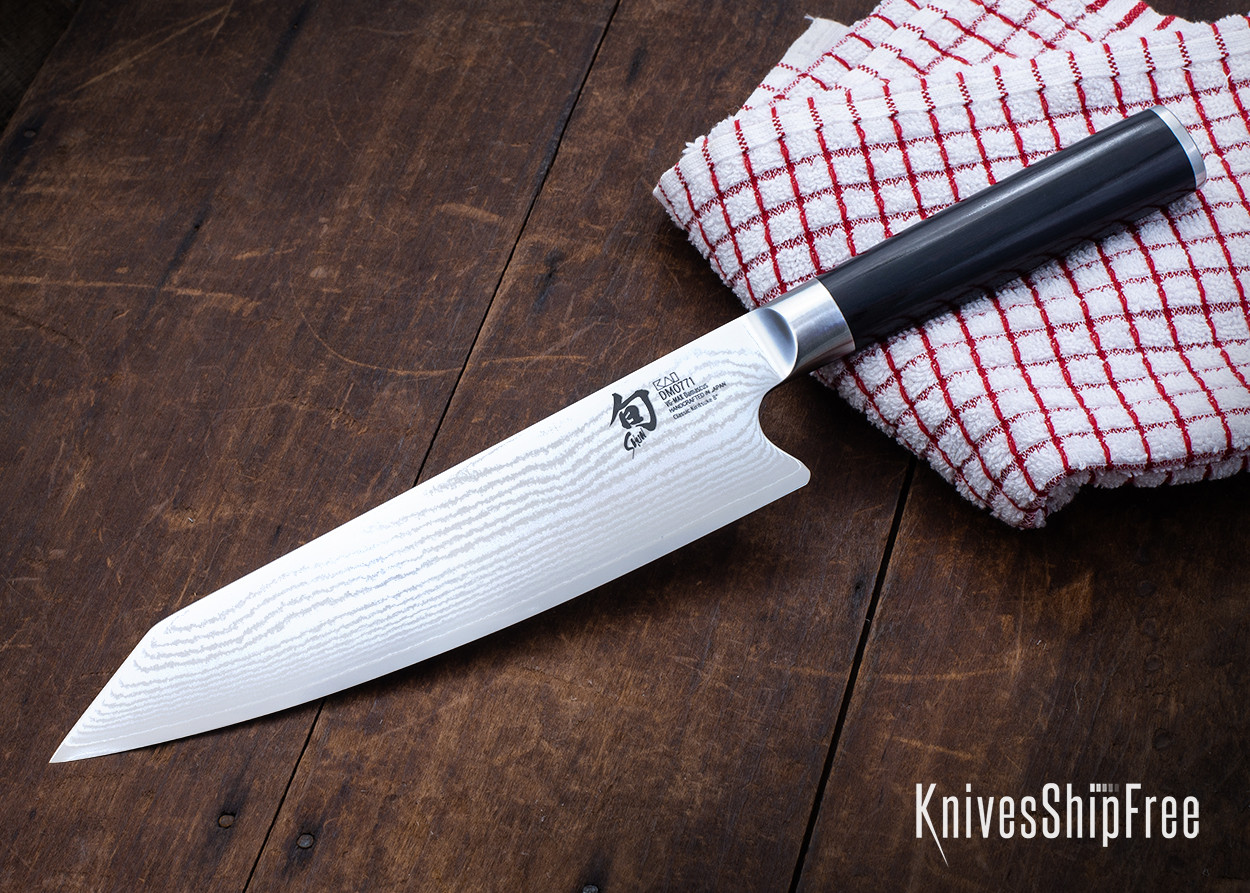
The steel explains the chips
Shun's core steel, VG-MAX, runs around 61 HRC, and the factory edge is ground to roughly 16 degrees per side. That combination cuts cleanly through tomato skin and holds the edge for weeks. It also means the edge has very little material behind it, so a sideways load or a hard impact takes a piece out instead of rolling the edge over.
Frozen food, bones, pits, squash and crusty bread all put that kind of load on a thin edge. Shun's own care guidance excludes those jobs. A European knife at 56 HRC and 20 degrees per side survives them by deforming, which is why the same motion that dents a Wusthof can chip a Premier.
- Harder steel: better edge retention, less tolerance for impact
- Narrow bevel: cleaner cuts, thinner supporting material behind the edge
- Honing a chipped edge: realigns nothing, and can enlarge the damage
What the warranty actually covers
Kai USA's limited lifetime warranty is for the original owner and is not transferable. It covers defects in materials and workmanship, and it requires a purchase from an authorized dealer. Normal wear, rust, accidents and misuse are excluded, and edge damage from cutting something hard falls into the last category.
Service runs through Kai USA for knives bought in the US, Canada or Mexico. There is a $15 return shipping and processing charge, plus whatever it costs to send the knife in. Owners outside those countries have to go through their local distributor, on that distributor's terms.
The free sharpening program is separate from the warranty and has limits of its own. A technician can restore an edge, but a chip that reaches past the bevel may need a reprofile that removes measurable blade width, and a broken tip may not be repairable at all. Sending three knives means three sets of fees, which is worth knowing before the box goes out.
The storage detail worth changing
Those knives lived in the sheaths they shipped in. Plastic edge guards and fabric-lined sleeves hold moisture against a blade and trap grit that grinds at the edge every time the knife goes in or out. A dry drawer, a magnetic strip or a wooden saya does less damage over five years.
The $15 covers return shipping and processing on a knife Kai agrees to service. An edge a technician reads as impact damage comes back either sharpened or with an estimate, and the second outcome costs more than the first.