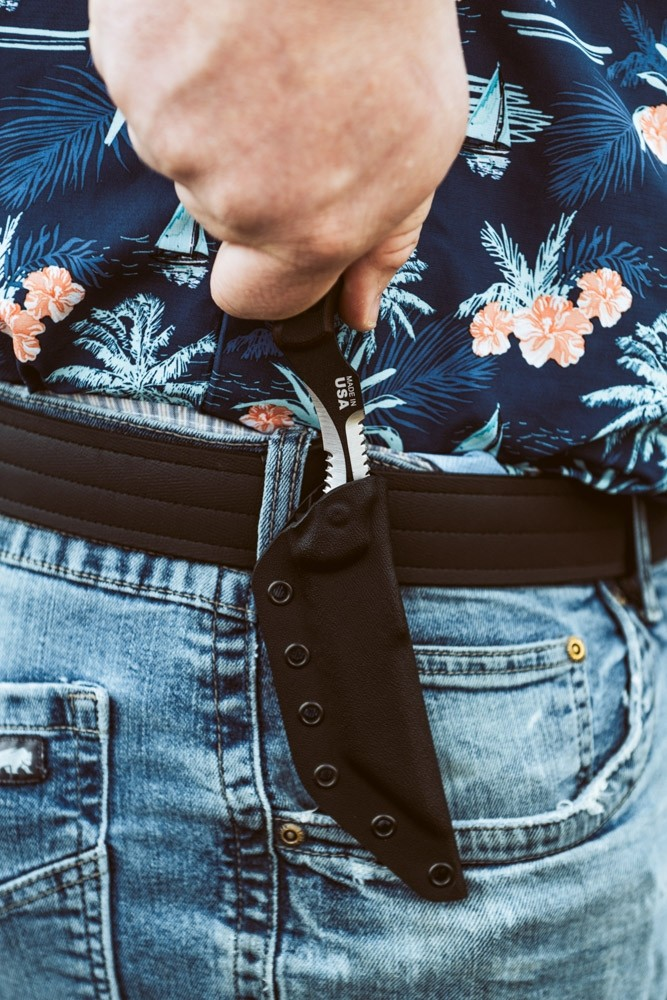
The thumb breaks the knife free of the Kydex and the draw angle is whatever you set the rotating spring-steel clip to, because the Back Bite Serrated ships in a pancake sheath that rotates on the belt. That clip is why a double-edged 8.5-inch fixed blade can ride on a hip all day, and TOPS has kept it unchanged from the original.
Sixteen years in, then teeth
The Back Bite has been in the TOPS catalog since 2010, when the company built it with Colin Despins around principles from Russian martial arts. Until now every version ran plain edges. The new Serrated Back Bite puts a full run of teeth on both live edges and swaps the original's black linen Micarta for red and black G10. Weight ticks up from 5.5 to 5.7 ounces, and the Kydex sheath carries over with the rotating clip.
TOPS lists the serrated version at $235 against a $295 regular price during the launch window, and Smoky Mountain Knife Works already had it at $216.99 before selling out. The plain-edge original now sits at the same $235 on TOPS' own site, so the serrations cost nothing extra right now.
The shape that never fit a category
There is still nothing on the market that looks like it. The 4-inch blade carries roughly 4 inches of live edge split between a 3-inch primary edge on top and a 1-inch secondary on the heavily recurved bottom, wrapped around a concave strike face. The back edge runs a Wharncliffe line into a flat chisel point. Despins designed the whole geometry around the pull stroke: the thrust lands the main edge, the reset drags the secondary edge back across, and the concave face between them traps and hooks at close range.
KnifeNews called it a super-modified, dagger-ground chisel-tanto when the serrated version landed on November 4, which is as close to a category as the shape has ever gotten. Serrations change what each contact does. A polished plain edge slices; teeth bite into rope, webbing and heavy clothing and tear. On a knife built around grabbing and ripping rather than clean slicing angles, the modification follows the design's own logic.
1095, 56-58 HRC, and the upkeep bill
The platform under the teeth is unchanged: 0.19-inch 1095 carbon steel hardened to 56-58 HRC under TOPS' black traction coating, full tang, made in the USA in the Rocky Mountains. 1095 is tough and cheap to sharpen, and it rusts on a schedule if you let it, so TOPS' care guidance is what it always is: keep it dry, oil it, and touch up teeth with a ceramic or diamond rod instead of a flat stone. Serrations hold a working edge through fibrous material longer than a plain edge and punish you at the bench when they finally dull.
Two other checks before ordering. Double-edged fixed blades are restricted in some jurisdictions, a warning TOPS prints on the product page itself. And this remains a self-defense tool before it is a camp knife, whatever the marketing flexibility of a 1095 blade suggests.
Both edges bite, and that is the version this design always wanted.